The best days on Amsterdam's water are the ones where you stop wherever the day takes you: a terrace on the Amstel, a swim off a quiet kade (quay), a coffee run in the Jordaan. The whole trick is knowing where you can actually tie up, for how long, and what it costs. This guide pulls that together.
We list spots as suggestions, not permits. The signs on the quay always win, so read them before you make fast. With that said, here is how mooring in Amsterdam really works.
The four kinds of tie-up
Almost every place you can stop falls into one of four buckets. Knowing which one you're looking at saves you grief.
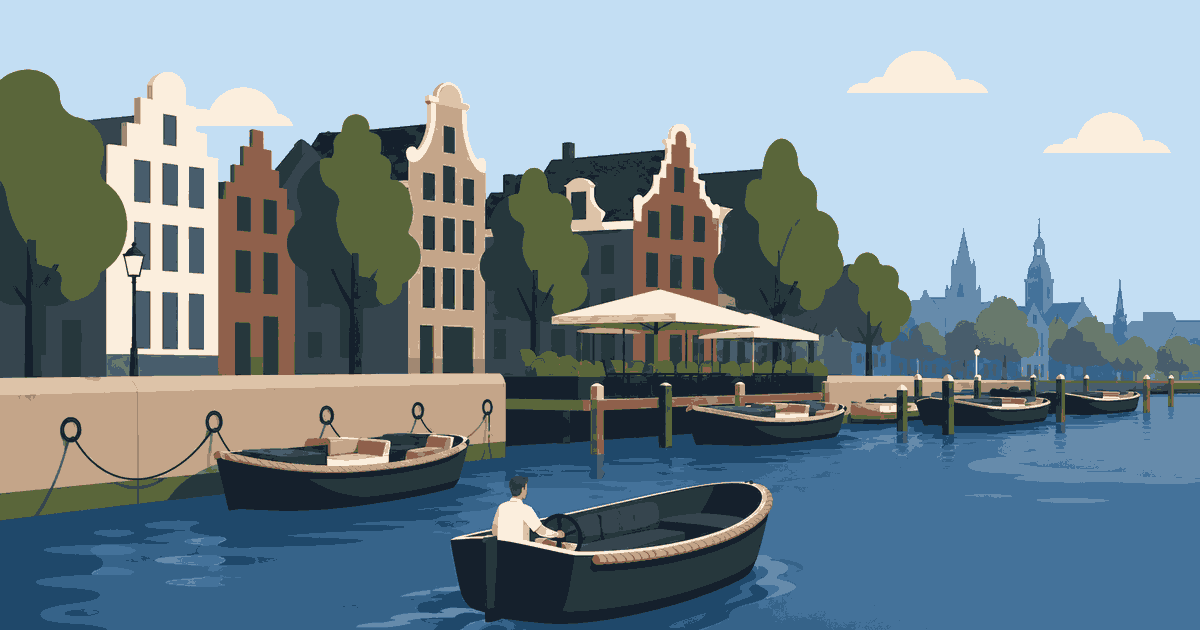
- Public quays (kades): a canal wall with rings or bollards, open to any boat for a short stop. The bread and butter of a day out. Often time-limited, rarely signposted as "free," but free to use unless a sign says otherwise.
- Floating docks (drijvende steigers): a pontoon that rides up and down with the water, so it's an easy step on and off. You'll find these at some parks, venues, and swim spots.
- Mooring poles (meerpalen): a row of posts you raft up to rather than a wall. Common on busier open water and at clubs.
- Scenic landmarks: a bridge, a lock, or a pretty bend you'll want to slow down for. Lovely from the water, but not a place to tie up. Enjoy it on the way past and keep moving.
A spot on a map is a suggestion, not a permit. Conditions and signage change, so treat the categories above as a way to read what you're seeing, not a guarantee.
What it costs: free quays, the vignette, and paid berths
There are two separate money questions, and people often muddle them.
The mooring itself. Most public quay tie-ups don't charge you to stop. Marinas and private berths do, because you're paying for a service or someone's spot. A private dock at a restaurant is usually "free" only in the sense that you're expected to be a guest and spend something while you're tied up.
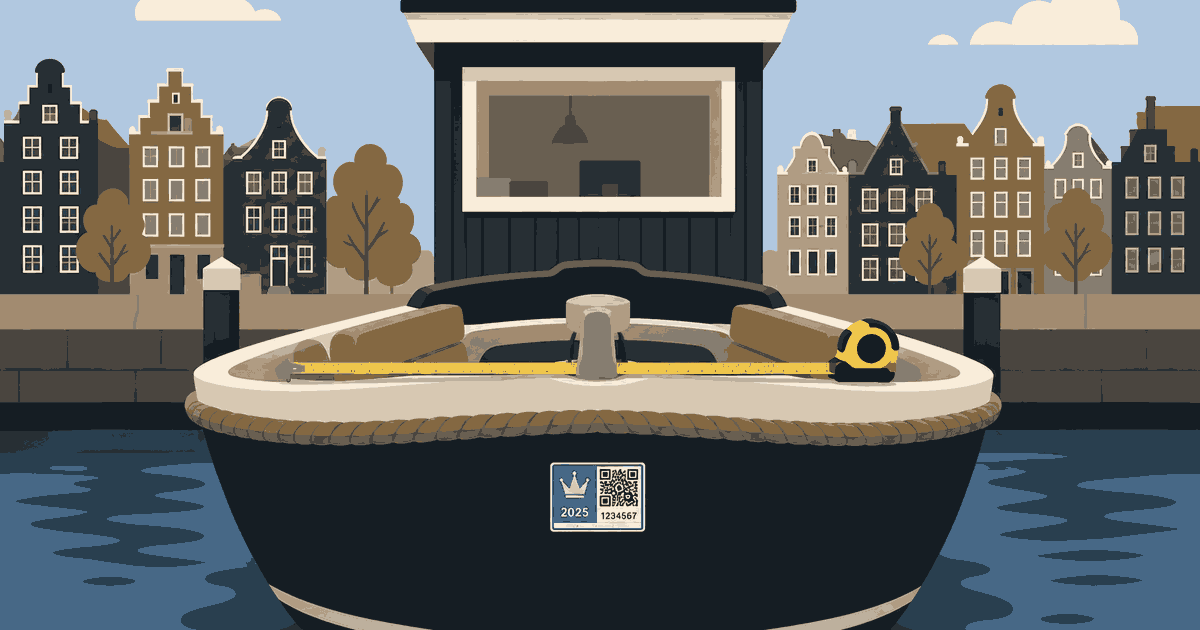
The boat's permit. Separately, any boat sailing or mooring in Amsterdam needs a vignet (a vignette, the boat equivalent of road tax). There are two kinds: an annual binnenhavengeldvignet for boats kept here, and a transit vignette (doorvaartvignet, €45, valid three years) for passing through, with cheap add-on day-mooring permits (6 hours or 24 hours). Boats must be under 10 metres to qualify in Amsterdam. We break down both vignettes, the costs, and the electric discount in the boat vignette guide. Fees and rules change, so check the City's apply-for-a-vignette page before you rely on a figure.
So a free public quay is free to stop at, but you still need a valid vignette to be on the water at all.
The rules that actually matter when you moor
You don't need to memorise the bylaw, but a handful of rules keep you out of trouble (and out of the way):
- Make fast to fixed gear only: rings, bollards, or mooring poles. Never tie to trees, bridge railings, lampposts, or bike racks.
- Mind the no-mooring signs. "Verboden af te meren" means no mooring, and you'll see it under many bridges and near swimmers' steps and ropes.
- Don't block the way. Leave the navigable channel, ferry landings, lock approaches, and ladders clear.
- Keep it short and keep it quiet. Many free tie-ups are short-stop only; leave room for the next boat. Loud music or shouting near homes can draw a noise fine.
- Boats over 10 metres can't moor in the city without an exemption.
The City's safe-boating page is the source for the speed limits, lighting, and the full mooring etiquette. Our Amsterdam canal rules guide puts the day-to-day version in plain language.
The emission-free zone changes where petrol and diesel boats can moor
Since April 2025 the city centre, including the Singelgracht, is an emission-free zone for pleasure craft. Electric, hydrogen, and muscle-powered boats can enter freely; petrol and diesel boats are kept to through-routes outside the zone (the Kostverlorenvaart route to the west, the Amstel route to the south-east, the Western and Eastern Islands) unless they hold a transition permit. If you run a combustion engine, this shapes which quays you can reach, so it's worth understanding before you plan a route. The detail and the permit deadlines (which keep shifting) are on the City's emission-free-zone page.
Where to find good tie-ups, by area
Every part of town has its own mooring character.
- The Jordaan and the western canals: pretty, central, and busy. Short stops on the grachten (canals) between errands, with the Western Islands (Westelijke Eilanden) nearby for a quieter corner.
- Oost and the Amstel: more room and some of the best waterside eating, with own-dock restaurants on the Amstel itself.
- The west, Kostverlorenvaart to the lakes: the route that strings the Oud-West canals down to the Nieuwe Meer and the Sloterplas for a swim, without fighting the centre's traffic.
- Noord and the IJ: open water and a different feel, but the IJ is working harbour water shared with big traffic. Cross it with care and save it for calmer weather.
The fastest way to see what's where is the map. Filter to Docking & Mooring for public tie-ups, or browse Eat & drink, Swimming and Supermarkets to plan the stop first and find the dock near it.
If you'd rather follow a ready-made day, our boat-curated collections string good tie-ups together by theme, like a sunny day in the west or waterside eating in Oost.
Go deeper
- Free mooring in Amsterdam: where and when covers the public tie-ups and the honest catches.
- Quiet canals for overnight tie-ups is for when you want peace, not the centre.
- Amsterdam canal rules covers speed, right of way, and the etiquette that keeps everyone happy.
Always check the current rules
Mooring rules, time limits, fees, and zones change, and they vary by area and season. Before you tie up, read the signs on site and check the latest local rules, then follow them. Floating Today lists spots as suggestions and isn't an official source. The City of Amsterdam's boating hub is the place to verify anything binding, and our Terms have the full picture.