Before you worry about where you can tie up, there's a simpler question every Amsterdam boat owner has to answer first: am I allowed to be on this water at all? The answer is a vignet (a vignette, the boat's equivalent of road tax). Almost every pleasure boat using Amsterdam's canals and harbours needs one, and which kind you need depends on whether you keep your boat here or you're just passing through. This guide untangles the two, what they cost, and how to get one.
As always, the figures here move (the City re-indexes them most years), so treat the euros as a guide and confirm the current number on the City's vignette page before you pay. The structure below doesn't change nearly as often.
The short answer
Any boat sailing or mooring in Amsterdam needs a valid vignette. There are two kinds, and you need exactly one of them:
- A transit vignette (doorvaartvignet) if you're passing through, a visitor or an occasional guest on the water.
- An annual inland harbour dues vignette (binnenhavengeldvignet) if you keep your boat in Amsterdam and use it through the season.
Both are bought online and displayed on the boat. Neither one is a permit to moor in a specific place. That's a separate question, covered in our mooring guide. And one important size rule: to qualify in Amsterdam your boat generally has to be under 10 metres. Bigger boats need an exemption.
Which vignette is yours
The honest test is simple: do you keep the boat here, or visit?
You keep your boat in Amsterdam. You want the annual binnenhavengeld vignette (binnenhavengeld means inland harbour dues). It's valid for the calendar year and is the normal choice for any local owner who's out most weekends. Price depends on the boat (more on that below).
You're passing through or only out occasionally. The transit vignette is the cheaper, simpler option. It costs €45 for 2026, is valid for three years (the year of issue plus the next two), and includes one free 24-hour mooring you can activate on a day of your choosing. If you want more mooring time, you add cheap day-mooring permits (see below). For a boat that visits Amsterdam once or twice a year, this is plenty.
If you're not sure which camp you're in, the rule of thumb is frequency: out most of the season means the annual vignette pays off; a handful of days a year means the transit vignette.
What the annual vignette costs, and how it's worked out
The annual binnenhavengeld fee isn't a flat number. It's worked out from two things:
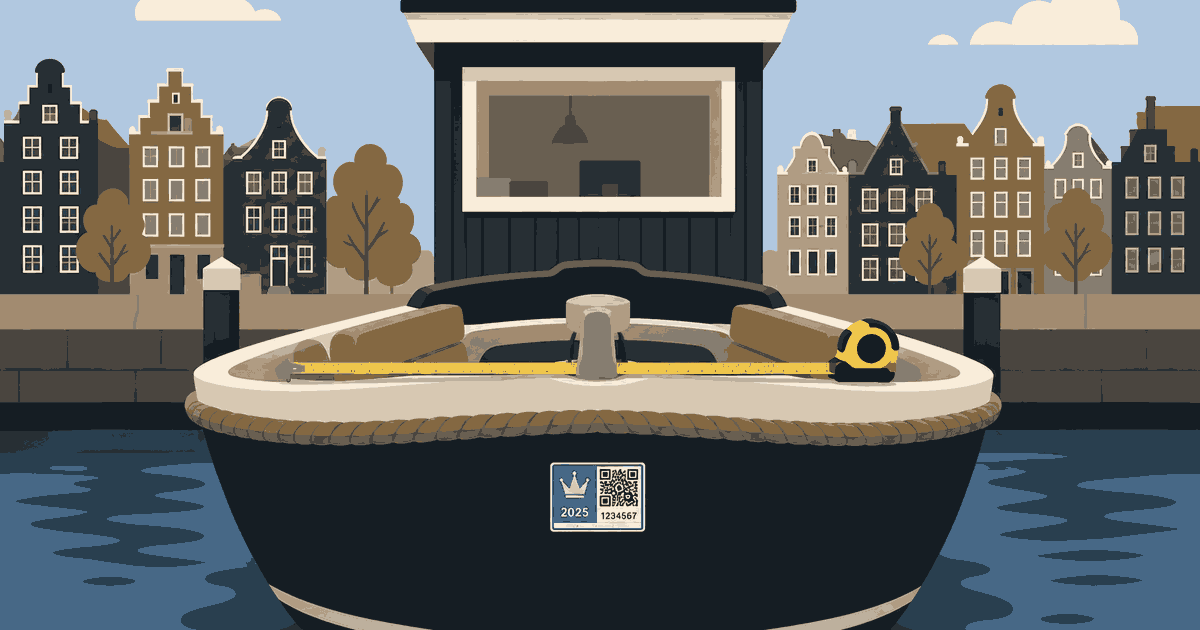
- Your boat's surface area. The City measures the greatest length × greatest width over the deck, in square metres, and rounds up to the nearest half-square-metre. A bigger boat pays more, in steps (area bands), each with a minimum amount.
- Your propulsion. There's a regular rate and a lower environmental rate (milieutarief), 25% off the regular price, for boats propelled only by electric, muscle, or wind power. Hybrids get the same 25% off, and a season subscription (abonnement) is 50% off. So going electric trims this bill as well as keeping you legal in the centre.
The 2026 rate bands
Each band has a starting amount, then a per-square-metre rate for the area above the band's floor. These are the Amsterdam regular-rate figures for 2026 (electric and muscle boats pay the environmental rate, 25% less):
- Up to 3.5 m²: €106 per m².
- 3.5 to 6 m²: €355, plus €60 for each m² above 3.5.
- 6 to 9 m²: €503, plus €60 for each m² above 6.
- 9 to 12.5 m²: €680, plus €60 for each m² above 9.
- 12.5 to 16.5 m²: €883, plus €60 for each m² above 12.5.
- Over 16.5 m²: €1,125, plus €60 for each m² above 16.5.
Most owners think in length, not deck area, so as a rough orientation: a typical open boat is around 1.6 to 1.9 m wide, which puts a 4 m boat near 6.5-7.5 m² (the 6-to-9 band), a 5 m boat near 8-9.5 m², and a 6 m boat near 10-11.5 m² (the 9-to-12.5 band). Measure your own to be sure, since beam changes it.
Boats based in the Weesp area pay reduced phase-in rates (the city took that water on more recently). The full table, including the Weesp, subscription, and hybrid columns, is in the City's tariff regulation, article 6.
A worked example
Say you run a small open sloep, 1.5 m wide by 4.2 m long. That's 6.3 m² of deck, which rounds up to 6.5 m² for the tariff, landing in the 6-to-9 band. With a 6 hp Suzuki four-stroke petrol outboard it's on the regular rate, so:
€503 + (0.5 m² above 6 × €60) = €533 for the year.
You can spread that over up to four instalments by direct debit (automatische incasso) rather than paying in one go. The same boat as an electric sloep would drop onto the environmental rate and pay around €400, a quarter less. That's the discount working in your favour, on top of the freedom to sail the centre.
Work out your own
- Measure your boat's greatest length and greatest width over the deck, in metres.
- Multiply them and round up to the nearest 0.5 m². That's your billable area.
- Find your band above and add the per-m² amount for the area over its floor. Take 25% off if you're electric, muscle, or wind powered.
- Confirm it in the City's official calculator on the vignette page, which returns your exact figure and the instalment option.
The rates are re-indexed most years (they rose by about 3.69% for 2026), so check the current figure before you pay rather than trusting last season's number.
Just passing through: the transit vignette and day-mooring
The transit vignette gets you onto the water, but it only includes that one 24-hour mooring. If you want to stop for longer over your visit, you buy day-mooring permits on top:
- A 6-hour mooring permit costs around €18.
- A 24-hour mooring permit costs around €34.
These are handy for a day of hopping between stops without committing to the annual route. You activate them for the day you need. As ever, confirm the current price when you buy, and remember a day-mooring permit lets you pay to stop, it doesn't override a "Verboden af te meren" (no mooring) sign on the quay.
The vignette is not a mooring permit
This is the single thing people muddle, so it's worth saying plainly. The vignette is the boat's right to be on the water, like tax and registration. Where you can actually tie up, for how long, and at what cost is a separate matter set by signs, zones, and the kind of quay or berth. A free public quay is still free to stop at once you hold a valid vignette, and a marina berth still costs marina money on top.
In other words: the vignette is necessary, but it's not the whole picture. Read the mooring guide for the tie-up side, and filter the map to mooring to see public quays.
How to buy it and where it goes
Both vignettes are sold by the City, not at a kiosk on the water:
- Buy online via the City's vignette page, or through the VaarWater app.
- You'll enter your boat's details (dimensions and propulsion), which is what sets the annual price.
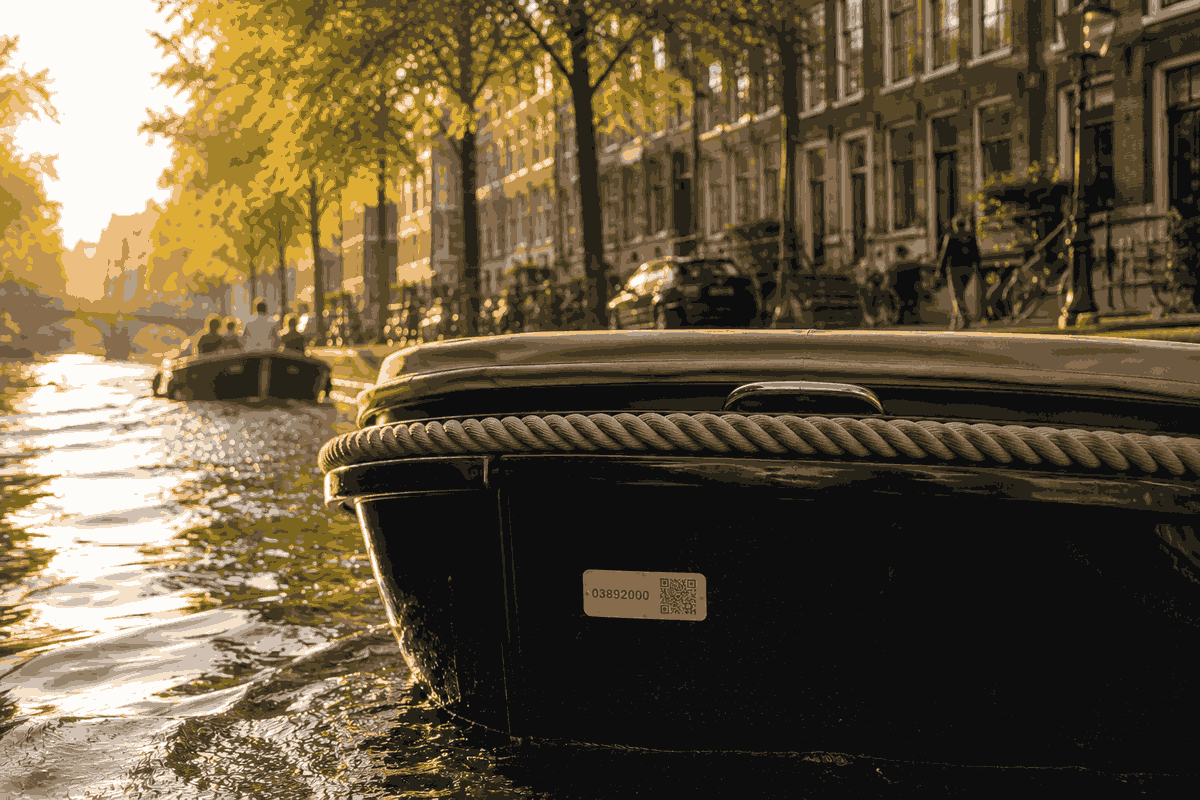
- Display it as instructed so it's visible from the water. Enforcement does check, and sailing without a valid vignette risks a fine.
- Manage it online at your account on mijnvignet.amsterdam.digitaalvignet.nl, where you can see your invoice, payment and instalment status, and your vignette details any time.
Keep the confirmation handy on your phone in case you're asked.
The emission-free catch worth knowing
Here's a connection that catches owners out: the vignette you held before 1 April 2025 sets your deadline under the emission-free zone. A boat that held the annual binnenhavengeld vignette gets a longer transition for combustion power (to 2030) than one on a transit vignette (to 2028). So your vignette isn't only a fee, it can decide how long a petrol or diesel boat may keep sailing the centre. We lay the dates out in full in does your boat have to go electric in Amsterdam.
Always check the current rates
Vignette types, fees, the size limit, and the day-mooring prices all change, and they're re-indexed most years. Before you pay, confirm the current figures on the City's vignette page, which is the binding source. Floating Today is a curated guide, not an official one. The City of Amsterdam's boating hub covers anything binding, and our Terms have the full picture.