Buying your first boat in Amsterdam is a brilliant feeling, right up until you discover the thing the seller didn't mention. A boat that can't legally sail the centre. A permit that doesn't transfer. An outboard that's banned. None of these are dealbreakers if you know to check for them, and all of them are expensive if you don't. This is the checklist we'd run through before handing over a cent, written for someone buying their first second-hand boat here.
A quick note in our usual spirit: this is practical guidance, not legal or tax advice, and the rules around permits and emissions keep shifting. We link the official pages, and the golden rule of buying is the same as mooring, check it yourself before you commit.
First question: where will you keep it?
Before you fall for a boat, sort out where it's going to live. In Amsterdam this is the real constraint, not the boat itself. A berth in a marina, a spot at a club, or a winter storage place can have a waiting list and a monthly cost that dwarfs the boat. Work that out first, because "I'll figure out mooring later" is how people end up with a boat and nowhere legal to put it.
Filter the map to marina for berthing operators, and read our mooring guide for how public tie-ups, berths, and costs actually work. If you've sorted the where, the rest of this list is about not buying the wrong boat for it.
The catch that costs people most: the emission-free zone
This is the big one. Since April 2025 the centre of Amsterdam (the water inside the Singelgracht) is emission-free: only electric, hydrogen, and muscle-powered boats may sail there freely. Petrol and diesel boats are kept to the through-routes around the edge.
Here's the trap for a buyer. The transition arrangement that lets some combustion boats keep sailing is tied to a vignette the owner already held before the cut-off. A brand-new vignette, the kind you'll apply for as the new owner, does not carry those old rights. So if you buy a petrol or diesel boat today and register it fresh, you may find you cannot sail it in the centre at all, only on the through-routes.
That doesn't make a fuel boat worthless, plenty of lovely water sits outside the zone, but it has to change the price you'll pay and where you plan to use it. If your dream is pottering the canal belt, buy electric or buy a boat you're willing to convert. Read does your boat have to go electric in Amsterdam for the deadlines and conversion costs, and confirm the current rules on the City's emission-free-zone page before you decide.
The vignette does not come with the boat
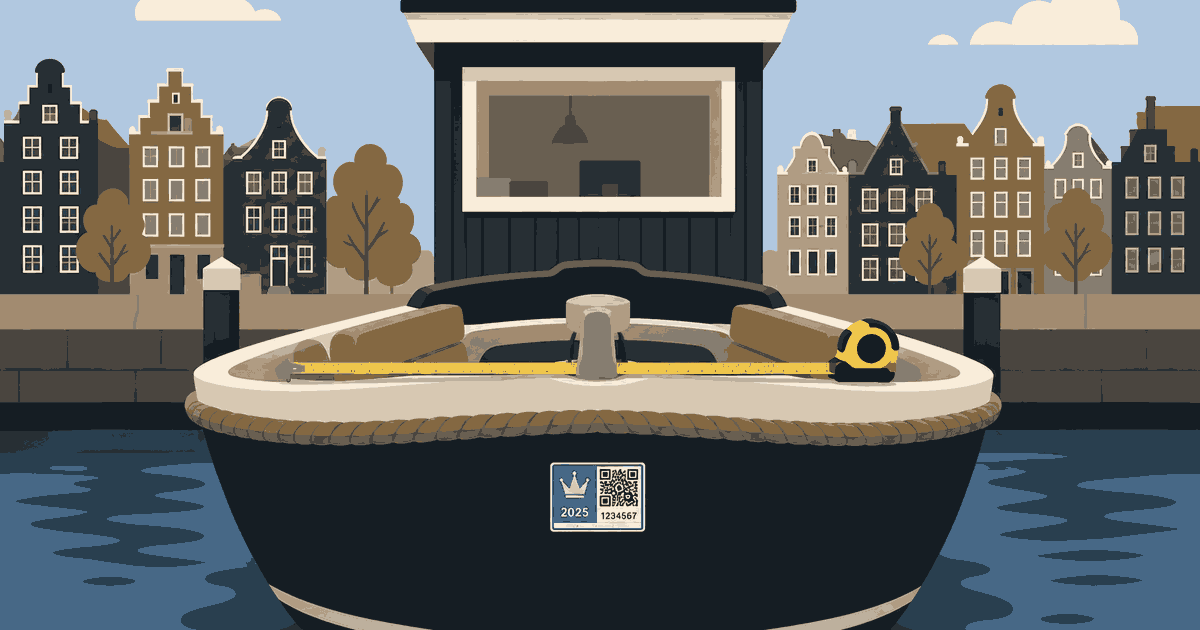
People assume a boat's permit transfers with the sale. It doesn't. A binnenhavengeld vignette can't be handed to a new owner: the seller has to cancel theirs, and you apply for a fresh one in your name. Two things follow from that:
- Don't pay extra for "a boat with a vignette." The vignette is leaving with the seller regardless.
- Budget for your own vignette from day one. What it costs depends on the boat's size and propulsion, and we break the whole thing down, with a worked example, in the boat vignette guide.
One more size rule worth knowing before you buy big: to qualify for a vignette and moor in Amsterdam, a boat generally has to be under 10 metres. Longer boats need a hard-to-get exemption (historical value, resident owner, a 2008-or-later engine). If you're eyeing an 11-metre cruiser to keep in town, check that first. The City's change-or-cancel-vignette page covers the transfer rules.
Check the engine: the two-stroke trap
Amsterdam bans the dirtiest outboards. A two-stroke outboard motor older than 2007 is not allowed in the city (engines must meet EU regulation 2003/44/EC). A surprising number of cheap second-hand sloops still carry exactly that motor, so:
- Ask the make, model, and year of the engine, and check it against the rule before you buy.
- A boat with an old two-stroke may need a new engine, which can cost more than the boat. Factor it in, or walk away.
- The ban doesn't apply on the main through-routes, but if you want to use the city proper, it applies to you.
While you're at it, this is the moment to think hard about going electric anyway, given the zone. An electric boat sidesteps both the two-stroke ban and the emission-zone problem in one go, and pays a lower vignette rate.
The paperwork to demand
Never buy on a handshake. For any boat worth real money, get these before you pay:
- A written purchase agreement (koopovereenkomst) with both parties' details, the boat and engine identification, the price, and the date.
- Proof of ownership, so you know the seller can actually sell it.
- Proof that VAT is paid (btw), especially on a larger or imported boat. A btw-verklaring or older invoices in the seller's name are the usual evidence. This matters more the bigger the boat.
- No outstanding claims. For a registered boat, a check at the Kadaster ship register shows whether there's a mortgage or seizure against it. Don't inherit someone's debt.
- CE marking and the declaration of conformity for hulls between 2.5 and 24 metres. Its absence on a boat that should have it is a red flag.
If anything is "lost" or "I'll send it later," slow down. Honest sellers have their papers.
A reality check: cheap, old, and still brilliant
Here's the honest truth, and it cuts against the section above: in Amsterdam, almost anything that floats is a good time. A scruffy little open sloop with a tired outboard can give you the best summers of your life, and plenty of the boats changing hands here cost less than a second-hand bike with an e-motor. You don't need a survey and a folder of certificates to enjoy the water.
And a boat at that end of the market often won't have the tidy paperwork. No CE declaration, no VAT receipt, no clean register entry, maybe no real history at all. That's normal at the bottom of the market, not automatically a scam. So scale your caution to the price: the cheaper and older the boat, the less paperwork there is to chase, and the more you simply accept you're buying it as-is.
What you should still do, even on a cheap boat:
- Don't hand over cash for nothing. Pay by bank transfer so there's a record the money moved and to whom.
- Write a one-page agreement anyway: both names, the boat and engine details, the price, the date, two signatures. It costs nothing, protects you both, and you'll want proof of purchase when you apply for your vignette.
- Buy with your eyes open. You get what you pay for. A bargain boat is a bargain because of what it lacks, so enjoy it for what it is and don't expect it to be something it isn't.
Check the boat itself
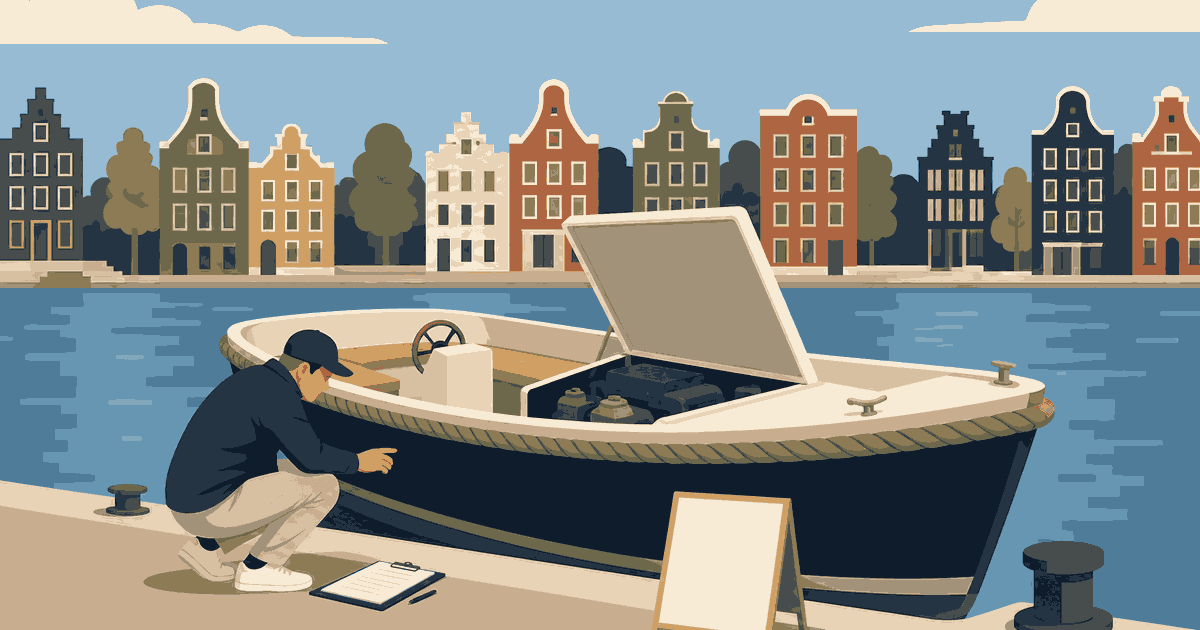
Paperwork aside, look the boat over properly:
- Match the hull number (the HIN or WIN stamped on the hull) to the documents. You'll need it later for the vignette and for any theft report.
- Get a survey (expertise or keuring) for anything older, bigger, or pricier than a simple open sloop. A few hundred euros spent on a surveyor can save you thousands. Filter to marine services for yards and surveyors.
- Take a sea-trial. Run the engine from cold, listen, check it doesn't overheat or smoke, and steer it under load. A seller who won't let you test-run it is telling you something.
- Look for the boring killers: soft or wet decks, osmosis blisters on the hull, corrosion around fittings, a tired battery bank on an electric boat.
Do you need a boating licence?
For most small boats, no. A vaarbewijs (boating licence) is only required for a fast motorboat (capable of over 20 km/h) or any boat over 15 metres. A typical electric sloop or a modest day-boat needs neither a licence nor national registration. The Amsterdam vignette, though, is separate and always required, licence or not.
After you buy
Once the boat is yours:
- Apply for your vignette straight away through the City's vignette page. You'll need the boat's dimensions, a photo, and proof of purchase with the date.
- Give the boat a name if it doesn't have one, every boat in Amsterdam must have one.
- Learn the basic rules before your first proper outing, our canal rules guide is the plain-language version.
- Set yourself up in Floating Today: choose "I own one," set your power type, and the map puts the right tie-ups, charging, and services front and centre.
Check before you commit
Permit rules, the emission deadlines, fees, and the engine rules all change, and a boat that's fine on one route may not be on another. Before you buy, confirm the current rules with the City and, for a boat of any value, lean on a professional survey. Floating Today is a curated guide, not an official or legal source. The City of Amsterdam's boating hub is the place to verify anything binding, and our Terms have the full picture.