If you own a petrol or diesel boat in Amsterdam, you've probably heard that the canals are going emission-free and wondered what it means for your boat. The short version: the centre already is emission-free, but you most likely have a few years before you have to do anything, and the exact deadline depends on which vignette you hold. This guide lays out who is affected, the dates that matter, and what going electric actually costs, so you can plan instead of panic.
A quick honesty note up front, the same one we put on everything: rules and deadlines here keep shifting, and the City is the only binding source. We link the official pages throughout. Use this to understand the shape of it, then confirm the current dates before you spend money.
The short answer
Since 1 April 2025, the heart of Amsterdam (the water inside the Singelgracht) is an emission-free zone for pleasure craft. Only fully electric, hydrogen, or muscle-powered boats may sail there without restriction.
If your boat runs on petrol or diesel, you are not banned overnight. A transition arrangement lets existing boats keep sailing for a few more years, and your cut-off date depends on the kind of vignette you already held. For most owners that means a deadline somewhere between 1 January 2028 and 1 January 2030. Around 2030, the emission-free rule is set to widen to the whole Amsterdam metropolitan area, not just the centre.
So the honest framing is: if you boat in the centre on combustion power, the clock is running, but you have planning time. If you're already electric, none of this touches you.
What the emission-free zone actually is
Uitstootvrij varen (emission-free boating) means the boat produces no exhaust emissions where it sails. In practice that's electric, hydrogen, or human power (oars, pedals, a paddle).
The zone is the old centre, within and including the Singelgracht, south of the railway line. That is the City's own wording, and the boundary below is the City's own map layer rather than our sketch of it, so it is the same shape our map and our routing use.
Two things are worth noticing on that map. It is two separate areas, and the second one east of the Amstel is easy to miss. And the northern edge is a straight cut along the railway, which is why the Westerdok and the Westelijke Eilanden (Western Islands) sit outside it.
The four routes that stay open
Petrol and diesel boats aren't shut out of the city. The besluit (the City's decision) deliberately keeps four stretches outside the zone so combustion craft can still cross town:
- The Kostverlorenvaart route: Westerkanaal, Singelgracht, Kattensloot, Kostverlorenvaart, Schinkel, Nieuwe Meer.
- The Amstel route: Oosterdok, Schippersgracht, Nieuwe Herengracht, Amstel.
- The Westelijke and Oostelijke Eilanden (Western and Eastern Islands) with the Nieuwe Vaart.
- The western Singelgracht, between the Kattensloot and the Hugo de Grootgracht.
This is the part most summaries skip, and it is the part that matters if you run a fuel boat: you can still get from one side of Amsterdam to the other. What you can't do is potter through the canal belt the way you used to.
The Amstel route is the one to remember, because it runs straight through the middle of that shaded area on the map. Geometry alone would tell you it is closed. It isn't.
What counts as emission-free
To sail the zone without a transition permit, your boat needs to be one of:
- Fully electric, battery or, in time, hydrogen.
- Muscle-powered: rowing boats, kayaks, canoes, pedal boats, sloepen under oar.
- Hybrid, while it is sailing emission-free. The City lists hybrids among the boats allowed in the zone, on the condition that they run emission-free the whole time they are inside it. Switch over before you enter and stay on electric until you are out.
That's the whole list. There is no "low-emission" or "clean diesel" exception inside the zone. The rule is about zero exhaust at the point of use, not about how new or efficient the engine is.
Find your own deadline
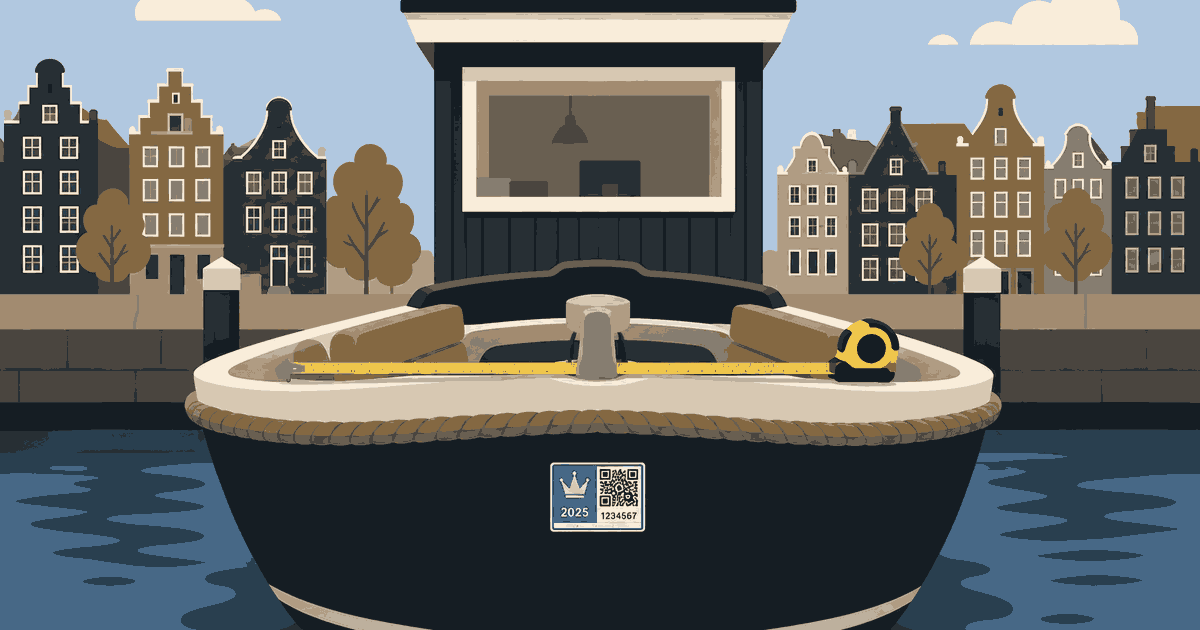
This is the part owners get wrong, so read it slowly. Your transition deadline depends on which vignette you already hold. (The vignette is the boat's permit to be on Amsterdam water at all, separate from the emission rules. We cover it in full in the boat vignette guide.) Per the City, here's how long an existing combustion boat may keep sailing in the zone:
- Transit vignette (doorvaartvignet, for passing through): until 1 January 2028 at the latest, and sooner depending on when you bought it. The City publishes it by cohort: a vignette bought in 2023 ran out on 1 January 2026 and no longer gets you in, one bought in 2024 runs to 1 January 2027, and one bought in 2025 (before 1 November) to 1 January 2028.
- Annual inland harbour dues vignette (binnenhavengeldvignet, BHG, for boats kept here), bought before 1 November 2025 and renewed each year: until 1 January 2030.
- FVEN historic-vessel register (varend erfgoed): until 1 January 2030, with both a vignette and an FVEN card.
A few things worth underlining:
- Selling the boat ends the arrangement, permanently. The City's formal decision on the zone (the besluit, the legal document behind the rule) is blunt about this: when a boat passes to another owner, its transition right lapses for good and does not transfer with the hull. Neither of the City's summary pages mentions it, so it catches people out. If you bought a petrol or diesel boat recently, assume you do not have the previous owner's runway until Mijn Vignet tells you otherwise.
- These transition rights attach to a vignette you already hold. A combustion boat coming new to the city, with a fresh vignette, doesn't get the same runway, so check the current rule before buying one.
- The annual BHG route only holds if you keep paying the inland harbour dues each year. Let it lapse and you lose the arrangement.
- Around 2030 the whole metropolitan area is due to follow the centre. So 2030 is the date to plan your boat's future around, whichever bucket you're in.
A note on the dates: you'll see different cut-offs quoted around the web (some sources say a 1 April 2025 cut-off, others 1 November 2025), because the scheme has been revised more than once. The figures above follow the City of Amsterdam's own emission-free-zone page, which is the only binding source, and your exact date shows in your Mijn Vignet account. Check yours there before you make a five-figure decision off any blog, ours included.
What going electric actually costs
For most owners, "going emission-free" means either converting the boat you love or replacing it. Conversion (swapping the combustion engine for an electric motor and a battery bank) is the common path for a boat worth keeping, and the cost depends mostly on size and how much battery you want.
Rough ranges seen around Amsterdam, as a planning guide only:
- Small sloep (6-8 m): €10,000-18,000
- Larger sloep (8-10 m): €15,000-25,000
- Sailing yacht (6-12 m): €12,000-30,000
- Motorboat (10-12 m): €25,000-45,000
- Larger vessels: €40,000 and up, sometimes past €100,000
What moves the number: the battery capacity (range costs money), whether the old drive shaft and prop can be reused, and how much rewiring and charging gear the boat needs. The honest takeaway is that a day-boat sloep conversion is a manageable project, while a big cruiser is a serious one. We walk through the whole job, outboard versus inboard, the battery, and getting quotes, in converting your boat to electric.
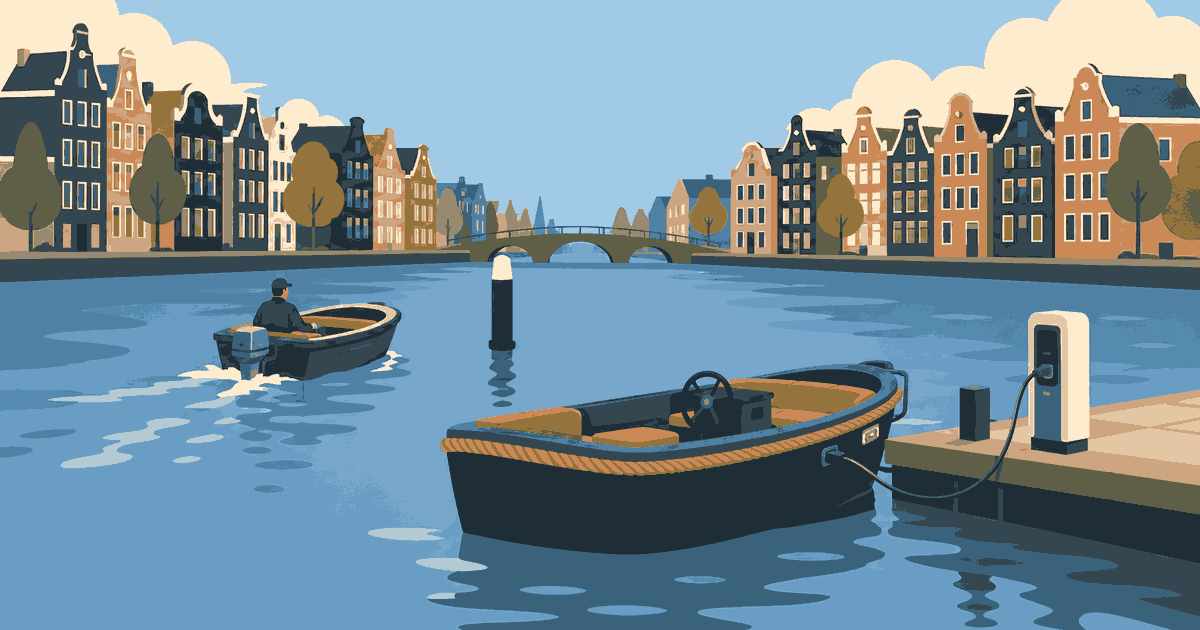
A practical wrinkle on the other side: once you're electric, charging on the water still has gaps. The City plans up to 2,500 pleasure-craft charging points before 2030, and the network is growing, but it isn't everywhere yet. Some quayside points are car chargers that need an adapter. We get into all of that in charging or fuelling your boat in Amsterdam. Filter the map to charging to see what's already on the water.
Sailing it without thinking about it
Reading a boundary off a map is one thing. Not having to think about it on the water is the useful part, and that is what the app is for.
Tell us what you sail, once. Under Profile, in Your boat, pick what powers it and, if it's petrol or diesel, which vignette you hold and when you bought the boat. That's four questions, and it's the only time you answer them. It needs an account, because the answer follows you to whatever phone you have on the day and to anyone you share a trip with.
The zone appears when it applies to you. On Explore and on Routes, the shaded area with the dashed edge is the zone. It switches itself on for a boat that has to stay out, and stays out of the way for one that doesn't. You can always turn it on yourself from the layers button.
Routes plans around it, and tells you when it can't. Plan a trip as a boat that may not enter and the line goes around the outside, with a note saying so. If there is no way round, because the place you asked for is inside the zone, you get the route you asked for and a plain warning rather than a refusal. The leaf button beside the layers control turns that off when you want the direct way.
The four open routes are treated as open. Because we route on named waterways and not on the polygon alone, the Amstel and the Kostverlorenvaart stay available to a fuel boat, exactly as the besluit intends. A tool that only tested whether a point falls inside the shape would send you the long way round water the City deliberately kept open for you.
On a shared trip, your crew see the rule and not your paperwork. Whether the day passes through the zone is everyone's business. What your boat runs on, and whether you hold a vignette, is not.
What to do now
You don't need to act today, but a bit of planning saves money:
- Check which vignette you hold. That single fact sets your deadline (2028 or 2030). If you're not sure, the City's vignette page shows what you have.
- Map your usual trips against the zone. If you mostly potter the centre canals on a fuel engine, the change matters to you sooner than if you stick to the Amstel and the lakes.
- Get conversion quotes early. Yards get busier as deadlines approach. Quoting now costs nothing and tells you whether to convert or replace. Find conversion specialists under marine services on the map.
- Plan charging into the boat. Know your future connector and where you'll top up. Set your power type to Electric in Floating Today so the map puts charging points front and centre.
- Re-check the official date before you commit. It has moved before.
Where combustion boats can and can't go more generally is in our canal rules guide, and where you can tie up is in the mooring guide.
The honest catches
A spot or a route on a map is a suggestion, not a permit, and the same goes for the dates here. Three things to keep in mind:
- Enforcement and detail evolve. The transition dates have already shifted once. Don't make a five-figure decision off a blog, ours included. Confirm on the City's page first.
- Signage on the water always wins. If a sign says you can't be somewhere, that beats anything you read here.
- The 2030 city-wide step is the one to plan for. Whichever transition bucket you're in, electric is where Amsterdam's water is heading. The owners who plan for it calmly, rather than at the deadline, get the better boats and the better prices.
Floating Today is a curated guide, not an official source. The City of Amsterdam's emission-free-zone page and boating hub are the places to verify anything binding, and our Terms have the full picture.