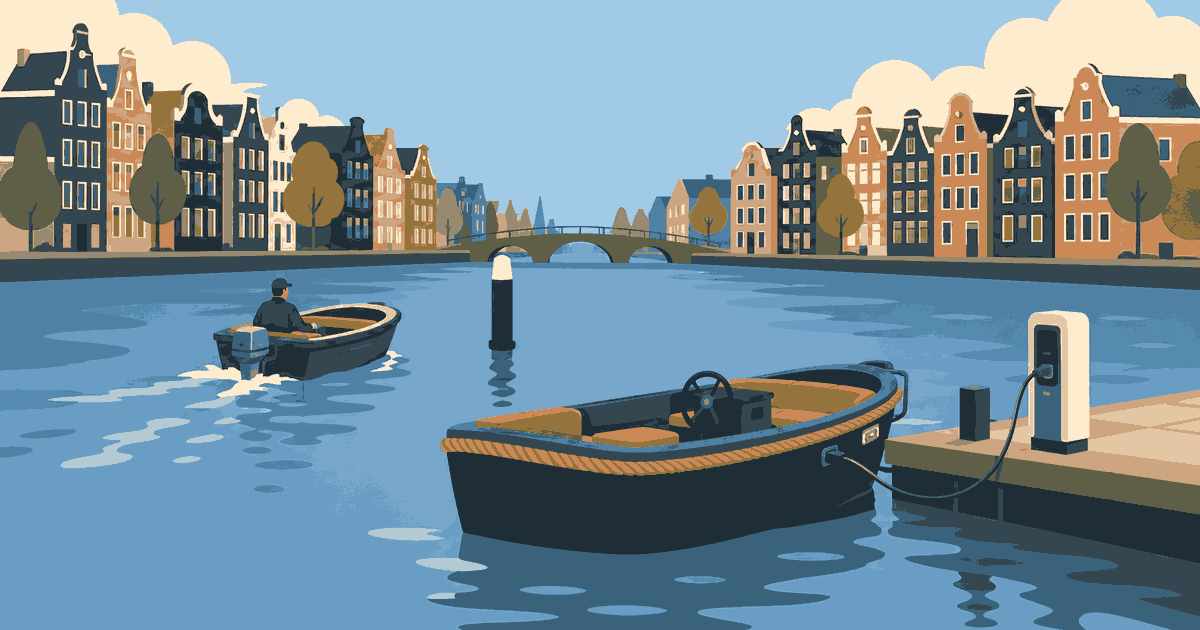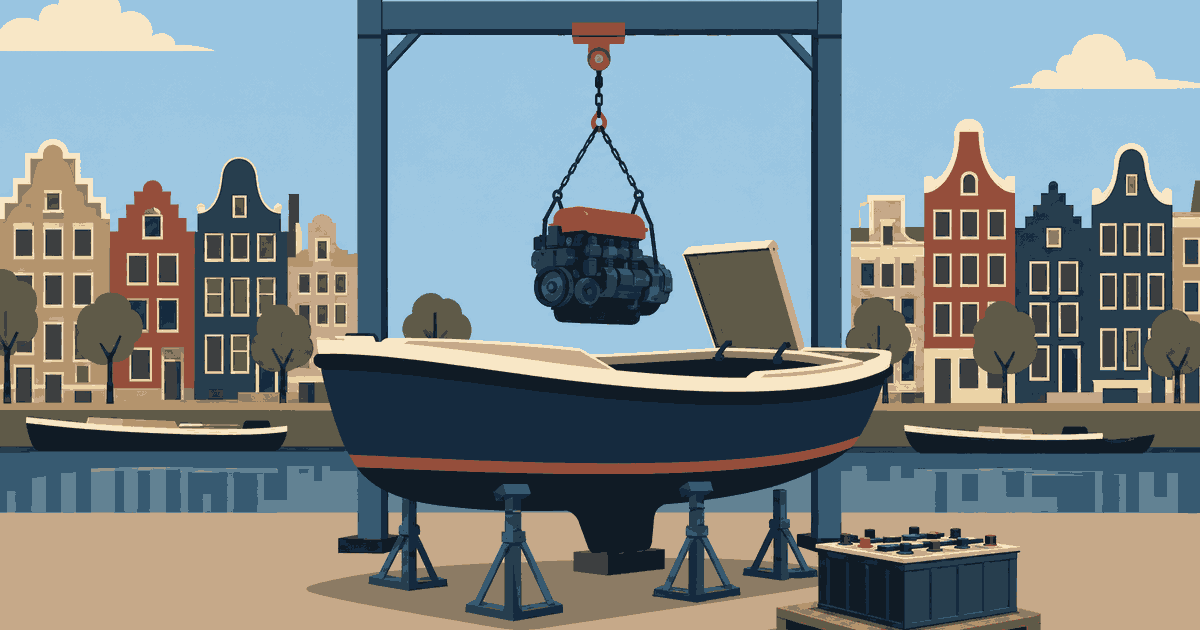
Sooner or later, Amsterdam's emission-free rules turn "should I go electric?" into "when?". If you've got a petrol or diesel boat you actually like, converting it is often the better answer than selling up and starting again. But it's a real project with a real bill, and the quotes vary wildly depending on what you want. This guide walks through how a conversion works, what drives the cost, and how to judge whether it's worth it for your boat. The deadlines behind all this are in does your boat have to go electric in Amsterdam.
As ever: this is practical orientation, not a quote. Prices below are what's been seen around Amsterdam, not a promise, so get your own quotes before you plan around a number.
Why bother converting
Beyond simply being allowed in the centre, going electric earns its keep:
- Centre access. Electric boats sail the emission-free zone freely, while combustion boats are pushed to the through-routes.
- A cheaper vignette. An electric boat qualifies for the environmental rate, roughly 25% off the annual binnenhavengeld. See the boat vignette guide.
- Quiet, and no fuel hassle. No engine drone, no fumes, no jerry cans, no two-stroke ban to worry about.
- Future-proofing. With the whole metro area due to go emission-free around 2030, a converted boat keeps its value where a diesel one may not.
The two ways to do it
How big a job this is comes down to what your boat runs now.
An electric outboard is the simple path, and it suits most small open sloepen. You replace the petrol outboard on the transom with an electric one and add a battery on board. It's close to a bolt-on, it's the cheapest route, and a capable owner can sometimes do much of it themselves.
An inboard electric motor is the bigger job, for boats with a diesel inboard. The diesel comes out and an electric motor goes in, often reusing the existing shaft and propeller, which saves money. Then you add the battery bank, a charger, and the wiring. This is yard work for most people, and it's where the cost climbs.
The honest dividing line: a small day-boat is a weekend-scale change, a classic cruiser with an inboard diesel is a proper refit.
The battery is the heart of it (and most of the cost)
Whatever the motor, the battery bank is what you're really buying, and it drives both the price and the range. Two things to get straight:
- Capacity (measured in kWh) is your range. More capacity means more hours on the water and a bigger bill. Be honest about the day you actually want, not the maximum on paper.
- Battery type. Lithium (LiFePO4) is now the norm: lighter, more usable capacity, and far more charge cycles than old lead-acid banks, though it costs more up front. For a boat you'll keep, lithium usually wins on the long run.
Size the battery to a realistic day of relaxed cruising rather than a theoretical marathon, and the whole conversion gets cheaper and lighter.
What it actually costs
Rough ranges seen around Amsterdam, as a planning guide only:
- Small sloep (6-8 m): €10,000-18,000
- Larger sloep (8-10 m): €15,000-25,000
- Sailing yacht (6-12 m): €12,000-30,000
- Motorboat (10-12 m): €25,000-45,000
- Larger vessels: €40,000 and up, sometimes past €100,000
These ranges line up with what local conversion specialists quote. A good example is the Amsterdam yard E-WERF, based on the Jachthavenweg, which has converted 350-plus boats since 2014 and builds its own marine lithium (LiFePO4) batteries: they put a small sloop conversion at roughly €13,500 and up, rising with battery size, motor power, and how much custom work the boat needs. Conversion yards and electric specialists around the city show up under marine services on the map. What moves the number: how much battery you want (range costs money), whether the old shaft and prop can be reused, and how much rewiring and charging gear the boat needs. The same figures appear in our emission-zone guide, because for most owners "going emission-free" and "converting" are the same decision.
Range and charging, honestly
A sensible conversion gives you a full, relaxed day of cruising on a charge, which is what most Amsterdam boating actually is. The catch is topping up. The city's on-water charging network is growing fast, with up to 2,500 pleasure-craft points planned before 2030, but it isn't everywhere yet, and some quayside points are car chargers that need an adapter. Plan where you'll charge before you commit, and read charging or fuelling your boat in Amsterdam for how it works. Filter the map to charging to see what's already on the water.
Getting it done
A few practical steps before you spend:
- Get two or three quotes from yards that convert boats regularly. Filter to marine services for boatyards and electric specialists around the city.
- Ask what range you'll really get, in hours of normal cruising, not the brochure figure.
- Ask what's reused. Keeping the shaft and prop, and a sound hull, keeps the cost down.
- Mind the weight and balance. Batteries are heavy, and where they sit changes how the boat floats and handles. A good yard plans this.
- DIY with care. An electric outboard swap is within reach for a handy owner, but a big lithium bank and inboard wiring is work you want done safely and properly.
Is there a subsidy?
Short answer for most boat owners: not really. The Dutch government's electric-sailing subsidy schemes are aimed at commercial seagoing vessels and shipping companies, not private sloops and pleasure boats on the canals. It's still worth asking your yard and checking the City's current pages in case a local incentive appears, but don't bank on a grant to make the sums work. Treat the conversion as an investment that pays back in centre access, a lower vignette, and resale value rather than in a cheque from the state.
The honest verdict: run the numbers
People expect electric to "pay for itself" in fuel savings. On Amsterdam's canals, it mostly doesn't, and it's worth seeing why before you spend. Let's run the same small petrol sloep we used in the vignette guide, a 1.5 by 4.2 metre open boat with a 6 hp petrol outboard, over a relaxed 50-hour season. These are illustrative assumptions, not quotes, so swap in your own.
Yearly running cost, keeping the petrol outboard:
- Fuel: ~2 litres an hour × 50 hours = 100 litres, at roughly €2.10/litre = ~€210.
- Servicing, oil, plugs, winterising: ~€200.
- Vignette (regular rate): €533.
- Total: ~€943 a year.
Yearly running cost, converted to electric:
- Charging: ~3 kWh an hour × 50 hours = 150 kWh, at €0.69/kWh = ~€105 (less if you charge from a cheaper shore supply).
- Maintenance: close to nothing, call it ~€40.
- Vignette (environmental rate, 25% off): ~€400.
- Total: ~€545 a year.
So electric saves roughly €400 a year here, about €130 of that on the vignette alone. Good, but now weigh it against the conversion: a small sloop runs ~€13,500. Even crediting the new petrol outboard you'd otherwise buy (say €3,000), that's ~€10,500 to find, and at €400 saved a year the payback is 20-plus years. A bigger diesel cruiser that burns more fuel and costs more to service tilts the maths a bit kinder, but rarely enough to pay back inside the boat's life.
The honest conclusion: don't convert to save money on fuel, because on canal-speed hours it won't, within any sensible horizon. Convert because the rules are heading one way: you keep the whole emission-free centre, you protect the boat's resale value as 2030 approaches, and you gain a quiet, fume-free boat with almost no engine maintenance. The annual savings are a bonus on top of that, not the reason. If your current boat is tired enough that it needs major work anyway, do this maths against simply buying an electric one instead.
Either way, the owners who plan the switch calmly, rather than at the deadline, get the better boats, the better quotes, and a quieter summer on the water.
Check before you commit
Costs, charging coverage, the emission deadlines, and any incentives all change. Before you spend, get firm quotes and confirm the current rules with the City of Amsterdam's boating hub. Floating Today is a curated guide, not an official source, and our Terms have the full picture.