Your first time at the helm on Amsterdam's water is equal parts brilliant and nerve-wracking. Narrow canals, other boats, a bridge coming up, and everyone on board looking at you. The good news: handling a boat here is a skill, not a talent, and it comes fast. The trick is to go slow, plan ahead, and let the water do half the work. Here's the calm version of everything that helped us in our first season.
One honest note up front: this is general guidance, not a substitute for a few hours with someone experienced aboard. If you can, take your first outing with a friend who knows boats. You'll learn more in an afternoon than in any guide.
The short version
Slow is smooth, and smooth is fast. Almost every first-season scrape comes from carrying too much speed. At idle, you have time to think, the boat answers gently, and a mistake is a nudge rather than a bang. Plan your approach before you need it, point the bow where you want to go, and remember that wind and current are doing things to the boat whether you notice or not. Get those three habits and the rest follows.
Before you cast off
A calm departure starts at the dock:
- Lines and fenders ready. Fenders out on the side you'll come back to, lines coiled so they run free, not in a knot under someone's foot.
- Know your controls. Where's neutral, forward, reverse? How much throttle does a gentle push take? Try them while still tied up.
- Learn which way she pivots. Most boats turn around a point near the middle, so the stern swings out the opposite way to the bow. Knowing that saves you clipping the quay as you pull away.
- Look before you move. A glance up and down the water for boats, paddlers, and swimmers, then cast off the lines and ease away at walking pace.
Steering and speed
Whether you've a tiller (push the opposite way to where you want the bow to go) or a wheel (turn the way you want to go), the golden rule is the same: keep the speed down and the boat will steer predictably.
A couple of things that surprise first-timers:
- You steer from the back. The stern slides out when you turn, so in a tight canal, line up early rather than yanking the helm at the last second.
- Reverse is its own animal. In astern, the boat barely steers and tends to pull to one side (prop walk). Use short bursts, be patient, and let it settle.
- Idle speed is your friend. The 6 km/h limit on most of Amsterdam's water is also about the right speed to stay in full control. No need to rush.
Coming alongside (the bit everyone dreads)
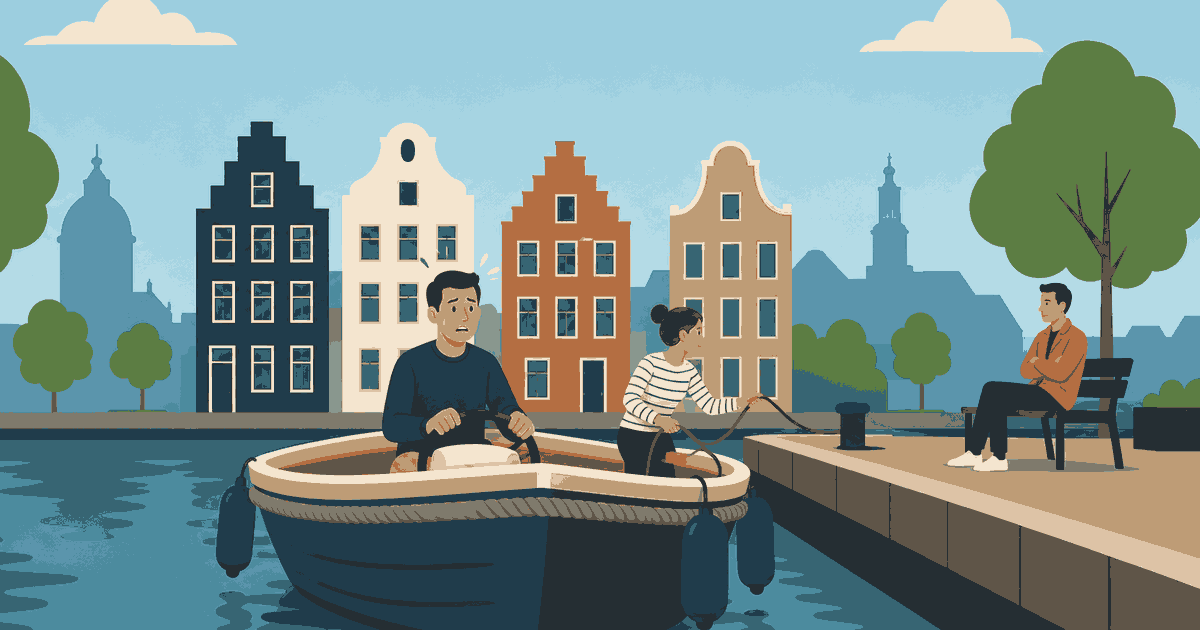
Mooring up is the move that makes new skippers sweat, so here's the calm method:
- Approach slow, at a shallow angle, aiming for a point a little ahead of your final spot.
- Come in against the wind or current where you can. They slow you down for free and push you gently onto the quay instead of away from it.
- Step, don't jump. When the boat is alongside and barely moving, step off with the line in hand. Jumping for the quay is how people end up in the gracht.
- Use a spring line. A line from the middle of the boat to the quay, with a touch of forward throttle against it, pulls the boat snug alongside and holds it there while you sort the rest.
If the approach looks wrong, don't force it. Idle past, loop around, and try again. Nobody's judging, and a second pass beats a crunch.
Reading the water and right of way
You don't need the full rulebook to feel safe, just a handful of habits:
- Keep right (stuurboord, starboard), even in the middle of a canal.
- Give way in good time, smoothly. Boats over 20 metres and working traffic always get room.
- Mind the busy junctions where canals meet, and slow right down near bridges and blind corners.
- Treat the IJ with respect. It's open harbour water with big vessels that have blind spots up to 350 metres and can't stop for you. Cross it with care, or save it for a calm day.
The full plain-language version is in our Amsterdam canal rules guide, with bridges and headroom and locks and sluices for the bits that need a little extra know-how.
The first-season mistakes to skip
We made most of these so you don't have to:
- Too much speed. Nine times out of ten, the fix for a hairy moment is less throttle.
- Fending off with hands and feet. A boat weighs tonnes. Use fenders and lines, never a limb.
- Panicking in reverse. Astern feels clumsy for everyone. Short bursts, breathe, let it settle.
- Tying to the wrong thing. Make fast to rings, bollards, or poles, never a tree or a bridge railing.
- Forgetting the air draught. Know your boat's height before you commit to a low bridge.
Where to build your confidence
Practise where it's quiet before you take on the centre. The open lakes and the calmer edges of the city are forgiving places to get the feel of coming alongside and turning in your own space. Our quiet canals guide points to the calmer water, and you can filter the map to mooring for easy, low-stress tie-ups to aim for. A few practice laps out there and the busy stretches stop feeling like a test.
Let Floating Today set you up
Open Floating Today, choose "I own one", and the map leads with the day-out kit so you're not hunting mid-canal: where to tie up, where to eat with the boat in sight, where to swim. Plan the stops before you cast off, follow a boat-curated collection for a gentle first day out, and you can keep your attention where it belongs, on the water.
Take it slow
Conditions, traffic, and the signs on the quay change by the hour, and they always have the final say over anything you read here. Go at your own pace, keep the speed down, and give yourself room to get it wrong gently. By the end of your first season, all of this will be second nature. Floating Today is a curated guide, not an official source. The City of Amsterdam's boating hub covers anything binding, and our Terms have the full picture.