Boat and outboard theft is one of the most common ways an Amsterdam boating season ends badly, but thieves go for the easy target, and a few cheap habits move you well down the list. Here's how bad it really is, the one thing that helps most, and what to do before and after it happens.
The honest scale of it
Across the Netherlands, roughly 1,200 boats and 2,100 outboard motors are stolen in a year. The part that stings: only about 5% of boats and 1% of outboards are ever recovered. An outboard is small, valuable, quick to unbolt, and easy to sell on in another country, which is exactly why they vanish.
So the mindset that works isn't "will the police get it back" (they almost never can), it's "make my boat more trouble than the one next to it." Thieves have options. Give them reasons to pick someone else.
The single best defence: take the outboard home
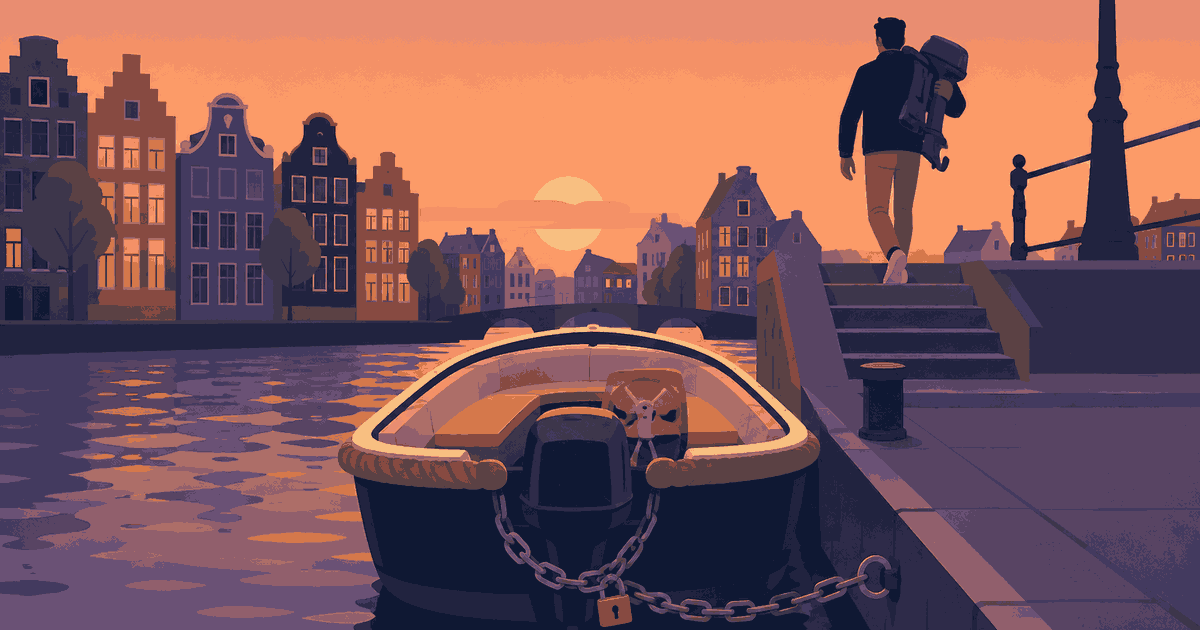
If your boat carries a removable outboard (buitenboordmotor), the lowest-risk thing you can do is simple: take it off and take it home when you're not using the boat. A motor sitting in your hallway cannot be unbolted from your transom in the dark. It's a faff, but it's the one habit that beats every lock, and it's free.
It also dovetails with winter: the same motor you carry home in November to keep it out of the frost (see winterising your boat) is the one a thief can't take. If you only adopt one habit from this guide, make it this.
If you can't take it off: lock it properly
Plenty of motors are too heavy to lug home every time. Then the rule is good locks, not token ones:
- Fit an approved outboard lock over the clamp screws so the motor can't simply be unbolted. Look for an ART or SCM mark, the two Dutch approval schemes for security products. ART rates locks from one to five stars; the more stars, the heavier the testing it survived.
- Chain the boat itself to a fixed ring or bollard with an approved cable or chain lock, not a bargain padlock that cuts in seconds.
- Lock what's loose: the battery, the fuel tank, electronics, and anything else that lifts out in one move.
Cheap security gear gets cut and is a false economy. One properly approved lock is worth three weak ones.
Where to buy, and the catch. The Dutch brands worth knowing are DoubleLock, Lockk and Powerlock, all developed here and all carrying ART or SCM approval. You will find outboard locks on Amazon.nl and a chain or padlock to go with them on Amazon.nl, but check the listing actually names an ART or SCM rating before you buy. Plenty of what comes up is generic and uncertified, which is exactly the false economy above, and an uncertified lock can also be the difference between a paid claim and a refused one. The specialist chandlers (Dekker Watersport, Nautic Gear, Slotenonline) list the approval on every product, which makes them the easier place to get this right.
Check your policy before you choose. Some insurers name a specific approval class, and fitting a lock one grade below it can leave you uncovered for the exact thing you bought it for.
Make the whole boat a poor target
Beyond the motor, a few habits make your boat the one thieves skip:
- Where you moor matters. A watched marina berth, a spot with lighting and passers-by, or a busier quay is safer than a dark, lonely corner. Convenience and security usually pull in the same direction here.
- Leave nothing on show. Take electronics, the GPS, life jackets, and valuables home. An empty boat is a boring boat.
- Use a cover. It slows a thief down, hides what's aboard, and they prefer fast and obvious.
- Put a camera on it. Cheap enough now to be worth it, and worth a section of its own below.
- Don't advertise the boat's empty for weeks. If you're away, ask a neighbour or your marina to keep half an eye on it.
Solar cameras: the thing skippers we know actually use
A few skippers we know have landed on the same setup, and it is the most practical bit of boat security we have seen: a solar-powered 4G camera with its own data SIM, clamped where it can see the transom.
Why that combination works on a boat, where most home kit does not:
- No wiring and no shore power. The panel keeps it topped up, so it is not another thing draining your battery or another reason to visit the boat in February.
- No WiFi needed. It has its own SIM, so it does not care that there is no network on the water. Newer models take an eSIM, which saves the fiddle of a physical card, and a prepaid data plan costs a few euro a month because a camera that only wakes on motion sends very little.
- Alerts at any hour. Motion wakes it and your phone buzzes, whether that is four in the afternoon or four in the morning.
- You can talk through it. This is the part people underestimate. The two-way audio means you can speak from wherever you are, and a voice coming out of the boat is a very effective way of ending someone's evening.
The Reolink Go range is the one most often mentioned, and the models with the pan-and-tilt head let you look around rather than at one fixed angle. They are on Amazon.nl, along with the matching solar panel if it is not bundled.
The honest limits. A camera does not stop a theft, it shortens it and gives you something to hand the police. It needs enough winter sun to stay charged, which on a north-facing mooring is not a given. And a lens pointed at a shared quay may catch your neighbours as well as your own boat, so angle it at your own transom and keep it off the walkway.
Even a visible dummy moves a thief to the next boat. The real one just also tells you about it.
Write down your numbers now, not after
This is the five-minute job everyone skips and everyone regrets. The single thing that gives you any chance of recovery, an insurance payout, or stopping a resale is knowing your boat's identifying numbers:
- The hull number (the HIN or WIN stamped on the hull).
- The engine serial number of the outboard.
- A few clear photos of the boat and motor, including any distinguishing marks.
Keep them somewhere off the boat (your phone and your email). You can also register your boat and motor in a theft database so a buyer or the police can check them: the national stolen-outboards database (stolen-outboards.net) and the insurers' VbV vehicle-crime register both feed police checks. You'll also need these numbers for your vignette, so it's the same homework twice over, covered in buying a boat in Amsterdam.
Electric boats: don't forget the battery
Going electric removes the classic petrol-outboard target, but it adds a new one: a marine lithium battery is expensive and worth stealing. Treat it like the outboard. Secure or remove the battery where you can, lock the locker it sits in, and note its serial number alongside the hull and motor numbers. The motor and controller are worth recording too.
If it does get stolen
Move fast and be thorough, because a complete report is the only thing that helps:
- Report it to the police. File online at politie.nl or by phone to their stolen-vehicles desk, with the hull and engine numbers and your photos ready. The more complete the report, the better the (slim) odds.
- Report a stolen vignette separately to the City, so it can't be misused, and request a replacement. The vignette guide and the City's change-or-cancel pages cover how.
- Tell your marina and your insurer straight away, and flag it in the theft databases above so a resale gets caught.
A word on insurance
Most owners under-insure, then discover the catch after a theft. Two honest points: check that your policy actually covers theft of the outboard and battery, not just the hull, and read the security conditions. Many insurers only pay out if the motor was secured with an approved lock, which is another reason to buy the right one. A cheap policy that won't pay is worse than none, because it costs you twice.
The short version
Take the outboard home when you can. Lock it and the boat properly when you can't. Write your numbers down today. Moor somewhere watched, and carry the right insurance. None of it is expensive, and together it turns your boat from an easy mark into someone else's problem. Floating Today is a curated guide, not an official source. The City of Amsterdam's boating hub and the police are the places to verify anything binding, and our Terms have the full picture.