There's no better end to a hot day afloat than slipping over the side for a swim. The honest news is the good kind: for most of the summer, Amsterdam's monitored swim spots are a yes. You don't need to be nervous about the water. You just want one quick habit for the handful of days when the answer flips to not today, because those are the days you really want to know before you go in.
This guide is that habit. Where it's safest, where it's fine but unwatched, and how to check in about thirty seconds.
The short version
- Monitored spots are the safe bet. Amsterdam has designated bathing waters the authorities test all season, and we show that official status on the map. Filter to Swimming, read the badge, and if it's clean, in you go.
- Other open water is allowed too, it's just not watched. Plenty of lovely spots away from the official list are perfectly legal to swim in. Nobody tests them, so there's no data either way, and we can't promise the water's clean today. People swim there all the time. We do too. You just lean on your own eyes and nose, and pick a monitored spot when you want certainty.
- The central canals are the one flat no. Busy navigation channels with boats and water taxis all day. Swimming isn't allowed, and the water isn't checked.
- Two things turn a good spot bad: blauwalg (blue-green algae) on hot, still days, and a riooloverstort (sewage overflow) after heavy rain. If either is flagged, or the water looks or smells off, give it a day.
- Whatever water you're in, swim smart: don't dive, don't swallow it, and keep your head up rather than under. Back on board, clean your hands with fresh water or sanitiser before you reach for the snacks. :)
Two reasons a good swim spot turns bad
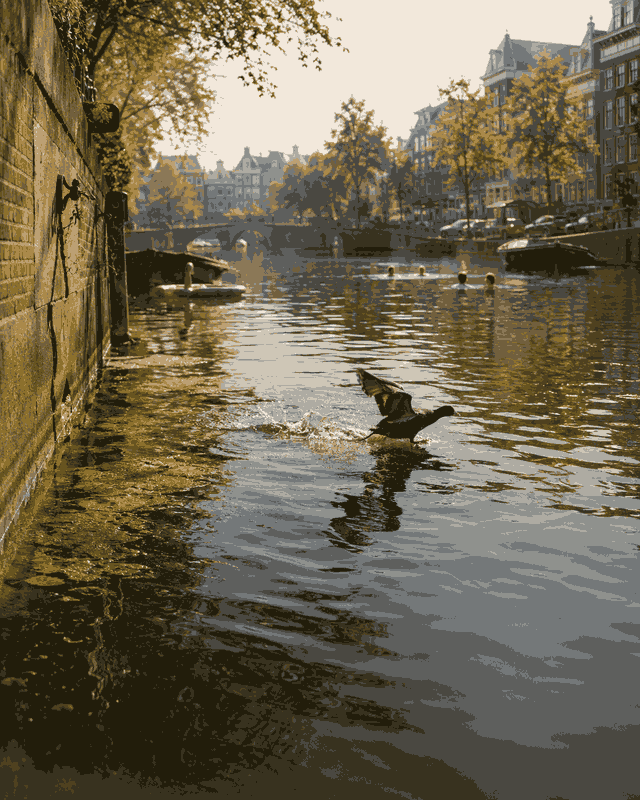
Amsterdam's swim water is clean most of the time. When it isn't, it's almost always one of these.
Blue-green algae (blauwalg)
The summer one. In warm, still weather, blue-green algae can bloom in the lakes, and bloom fast. It shows as a blue-green sheen, a paint-like film, or little floating flakes, often gathering on the downwind shore, sometimes with a musty smell. Swallow it, or swim through a heavy bloom, and you can come away with a headache, an upset stomach, nausea, or skin irritation. It hits children and dogs hardest, because they're smaller and swallow more.
Rule of thumb: if the water has a blue-green glow, a film, or a bad smell, stay out, even if no warning has gone up yet. A bloom can appear between official checks.
Sewage overflow after heavy rain (riooloverstort)
The rainy-day one, and easy to forget on a day that started sunny. After a heavy downpour, Amsterdam's drainage can overflow and push untreated water, and the viruses and bacteria in it, into the open water. The waterboard then advises against swimming for a few days while it clears.
That is exactly what happened as this guide went out. On 28 June 2026, after a night of heavy rain, the Waterschap Amstel, Gooi en Vecht advised against swimming in open water across Amsterdam and the surrounding municipalities until 1 July. The water looked perfectly inviting the next morning, which is the whole point: you can't see this one. The only way to know is to check. It will happen again every summer, so hold onto the pattern: big rain, then wait a couple of days.
So how often is the water actually bad?
Not often. Across a whole summer it's a handful of days, not a constant worry. The default is swimmable, and the numbers back that up.
- Overflows are occasional, not weekly. They happen roughly 5 to 10 times a year, and only after a genuinely heavy downpour, when more than 12 mm of rain falls in a single hour. An ordinary summer shower doesn't do it.
- The water clears fast. After one of those overflows it takes about three days to run clean again, which is why an advisory like today's lasts a few days and then lifts.
- Most checks come back clean. At the Marineterrein, a popular city-centre spot that isn't officially monitored, only 9 of around 300 bacteria measurements between 2016 and 2024 went over the safety limit. That's about 1 in 30. The water there was fine the large majority of the time.
- When it is bad, it's properly bad, which is why the wait earns its keep. Two documented Dutch cases, an open-water championship in 2022 and the Roermond city swim in 2023, saw infection rates above 85%. Those were endurance events with swimmers in for hours, not a quick dip off the boat, so don't read 85% as your odds. Read it as proof that swimming straight after an overflow really does make people ill.
- The official spots are watched all season. Designated bathing waters are tested about twice a month from May to October. That's the data feeding the status badge.
Put it together and the pattern is simple: big rain, then wait two or three days. The rest of the season, a monitored spot with a clean status is a yes. This is exactly the kind of local intel a curated map should keep an eye on for you, so the call is a glance, not an afternoon of reading waterboard notices.
Amsterdam open water, a typical summer
Most days, the answer is: swim.
About 29 in 30 water checks come back clean (Marineterrein spot-checks, 2016–2024).
Sources: local Amsterdam research via oost-online.nl · RIVM · GGD Amsterdam · official status from zwemwater.nl.
floating.today · a curated guide to Amsterdam by boat
How to check in thirty seconds
You don't have to memorise any of this. You just have to look before you leap.
- Open the map. Filter to Swimming and tap the spot you're headed for.
- Read the status badge. On monitored spots we show the official water-quality status, the same one the authorities publish: Safe to swim, Warning, Negative swim advice, Swimming ban, Under investigation, or Outside bathing season. It carries the line "Official status from zwemwater.nl" and the date it was last updated, so you can see for yourself how current it is.
- Trust your eyes and nose. A status is a snapshot between checks. If the water has that blue-green sheen or smells off when you arrive, skip it whatever the badge says.
- On a close call, cross-check. zwemwater.nl and the Zwemwater app carry the live national register, and the GGD Amsterdam has the health guidance.
What we monitor, and what we don't
Here we'll be straight with you, because a swim is one place you don't want a half-truth.
The status badge only appears on monitored swim spots, the official bathing waters the authorities actually test through the season, such as the Nieuwe Meer, the Sloterplas, the Gaasperplas, and Het Twiske. On those we pull the official zwemwater status and stamp it with the date it was checked.
Plenty of good places to get in the water aren't on that list, and that's fine. A quiet lake edge, a spot off the beaten track, somewhere lovely you found yourself. Most are perfectly legal to swim in. They're just not tested, so there's no badge and no status, and we'll say so. Nobody's checking that water, so nobody, us included, can tell you it's clean today. People swim these spots all the time, and honestly, so do we. You simply lean harder on your eyes and nose, and head for a monitored spot when you want to be sure.
The central canals are the exception, badge or not. They're busy navigation channels with boats and water taxis all day, swimming there isn't allowed, and the water isn't checked.
Why we bother keeping it current
We pull the official status onto the monitored spots and refresh it regularly, and we show you the date of the last check right on the badge rather than hiding it. We're not claiming a live, by-the-minute feed. The official data itself only moves about weekly, so a date you can see beats a "live" label you have to take on faith.
We do it because a swim is exactly the kind of decision where a curated map should do the homework for you. You shouldn't have to comb three official sites while everyone's waiting to get in. Glance at the badge, glance at the date, and you've got your answer.
Make the most of a swim day
Once the water's a yes, the rest is the fun part. A swim pairs beautifully with a shaded tie-up and a cold drink, and we've strung a couple of ready-made days together: the Swimming Outside the Old Centre round-up, and the Heatwave Swim Route to the Nieuwe Meer for a longer day out west.
Where these numbers come from
We lean on the official and the local, and link each so you can read it yourself:
- oost-online.nl: local Amsterdam reporting on wild swimming. Source for the overflow frequency (5 to 10 a year), the 12 mm-in-an-hour trigger, the roughly three-day clearing time, and the Marineterrein measurement record.
- RIVM: the national institute for public health. The documented post-overflow illness outbreaks, and why the few-day wait matters.
- GGD Amsterdam: the city's public health service. Testing cadence (about twice a month, May to October) and the health guidance on open-water swimming.
- zwemwater.nl: the national bathing-water register. The official status we show on monitored spots.
- City of Amsterdam: the 28 June 2026 negative swim advisory used as the worked example above.
Before you cast off
A swim spot on a map is a suggestion, not a guarantee that the water's safe today. Conditions change by the hour, especially after rain or in a heatwave, and the official status is a snapshot between checks. Read the signs at the water, swim only where you're confident it's clean, and when in doubt, wait a day. Floating Today is a curated guide, not an official source: the national zwemwater.nl register and the GGD Amsterdam carry the binding word, and our Terms have the full picture.