You don't need to own a boat to spend a day on Amsterdam's canals. Renting is straightforward, and for the small open boats most people want, you won't need a licence at all. What catches first-timers out is rarely the boat. It's the two-hour minimum they didn't budget for, the sunny Saturday that sold out ten days ago, or tying up somewhere that turns out not to be a tie-up.
Here's the version we'd give a friend.
Do you need a boating licence?
For a normal rental, no.
In the Netherlands a boating licence (vaarbewijs) is only required for a boat longer than 15 metres, or one that can do more than 20 km/h. Rental sloepen (open sloops) and electric boats sit well under both, so you can step aboard with no qualification at all. The general speed limit on Amsterdam's water is 6 km/h anyway, so nothing you can rent for a day out comes close to the licence threshold.
The company sets its own conditions on top of the law, and those are the ones that will actually affect you:
- A minimum age for whoever steers, usually 18 or 21.
- A deposit, held on a card and released after you return the boat.
- A maximum number of people, which is a safety limit, not a suggestion.
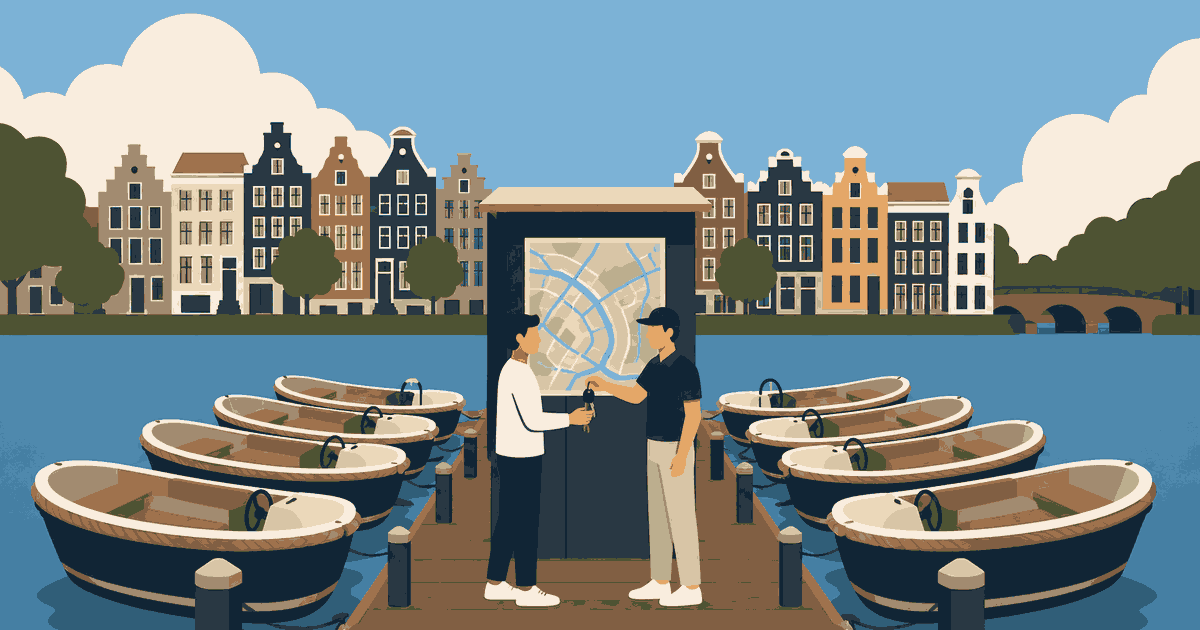
- A short briefing before you cast off. Take it seriously, it is the only tuition you get.
Ask about all four when you book rather than on the dock.
What it costs
Prices below are what the companies in our rentals directory currently list. They move with the season, so treat them as the shape of the market rather than a quote.
Self-drive, no skipper. Roughly €80-120 for a two-hour rental, depending on the season, the boat size and the company, almost always with a 2-hour minimum. Some price by the block rather than the hour, which works out cheaper if you want a proper afternoon.
With a skipper. A different bracket: from around €250 per hour for a private boat with someone driving. You are paying for a person's time, so it makes more sense for a group splitting it than for two people.
A shared cruise. From about €17.40 per person if you just want to be on the water and don't need the boat to yourself.
On top of the headline rate, check:
- Whether the deposit is separate (it usually is).
- Whether charging or fuel is included (with electric it normally is).
- Whether there's a late-return fee, and what counts as late.
- Whether life jackets are provided, and whether there are child sizes if you need them.
Electric or fuel?
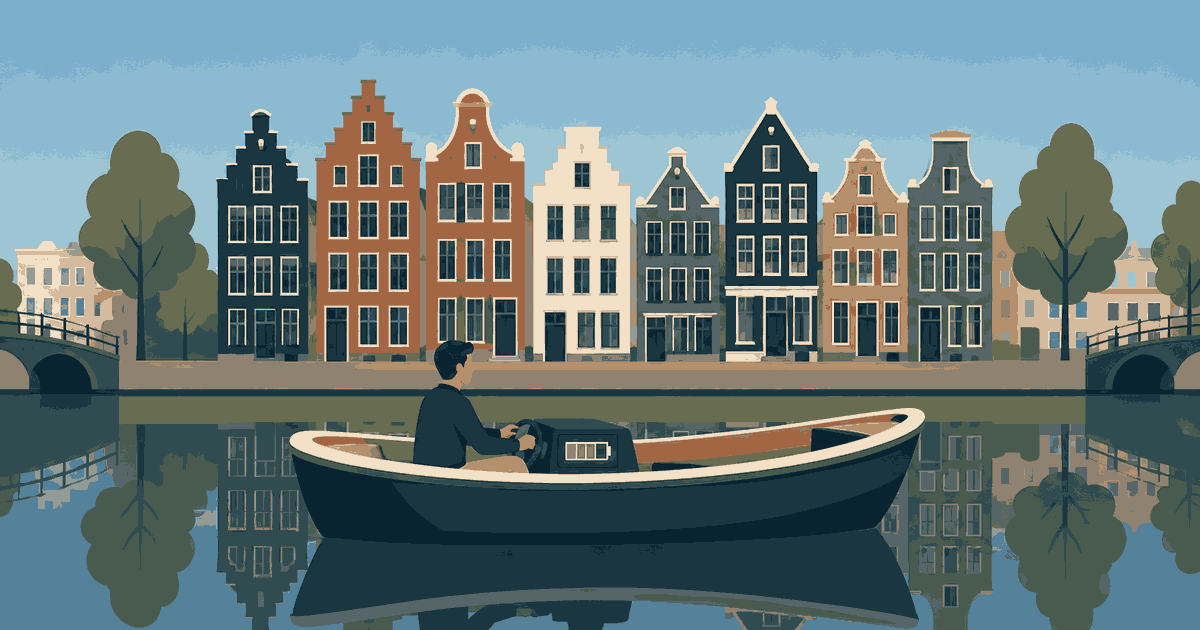
Most of the Amsterdam fleet is electric now: almost every self-drive rental in the city runs on a battery. For a day out that is simply the better experience. No engine noise means you can hold a conversation, and there's no fuel to think about.
There's a practical reason too. The city centre is an emission-free zone, and it is expanding. An electric boat can go where a combustion one increasingly can't, so choosing electric is partly about which canals are open to you. If you want the detail, we've written it up in the emission-free zone guide.
The one thing worth asking is range. A full battery is usually good for a comfortable day, but if you're planning a long run out to the IJ or the Nieuwe Meer rather than pottering round the grachten (the ringed canals), say so when you book and let them put you on the right boat.
When to book
- Sunny weekends sell out, often more than a week ahead. The moment a warm forecast lands, availability disappears. If your plan depends on a specific Saturday, book as soon as you know.
- Weekday mornings are the quiet gold. Same canals, a fraction of the traffic, and easier to find a spot to tie up.
- Late afternoon into evening is the nicest light and the busiest water. Lovely, but not the easiest first outing.
- Shoulder season (May, September) is underrated. Warm enough, far calmer, and easier to get the boat you actually wanted.
If it's your first time steering, pick a quieter slot on purpose. The centre canals on a hot Saturday are a slow-moving traffic jam, and learning to hold a boat straight in that is no fun.
Self-drive or with a skipper?
Self-drive if you want the day to be yours, you're comfortable with a bit of low-speed manoeuvring, and the group is relaxed about the odd bump. These boats are slow and forgiving, and most people have the hang of it inside twenty minutes.
Take a skipper if it's a celebration and nobody wants to be responsible, if the group is large, or if you want to drink properly. That last one matters: the alcohol limit applies on the water exactly as it does on the road, 0.5 promille for whoever is steering. If you plan to have more than one, someone sober needs the helm, or you pay for a skipper.
The rules you actually need on the day
Not the full rulebook, just what a first-timer trips over. There's more in our canal rules guide.
- Keep to starboard, which is the right-hand side, and hold it. Most near-misses come from drifting into the middle.
- 6 km/h is the general limit, a little more (7.5 km/h) on the Kostverlorenvaart, the Oosterdok, the Nieuwe Herengracht, and the Amstel heading out towards Ouderkerk. It's slower than it sounds. Watch your wake.
- Big boats have priority in practice, whatever the rule says. Tour boats and freight need room and can't stop for you.
- Noise carries over water and into people's homes. A complaint can mean a €140 fine, and the canals are lined with bedrooms.
- Don't swim in the canals. Swimming is forbidden in fairways and near bridges, locks and harbours. Go to a proper swim spot instead, where the water quality is actually monitored. We show each one's official status, refreshed daily. There's a fuller answer in is it safe to swim in Amsterdam.
- If you're out after dark, you need lights. A boat under 7 metres carries one all-round white light. Check the boat has one before you leave.
Plan the day, not just the boat
The boat is the easy part. The difference between a good day and a stressful one is knowing where you're stopping before you cast off.
A day that works usually strings together:
- A boat-friendly café or restaurant where you can tie up, or order to the boat without leaving it.
- A swimming spot if it's hot.
- A public toilet somewhere in the middle. Genuinely worth planning, especially with a group.
- A place to tie up near wherever you're headed, checked in advance rather than hunted for.
That last one is where most first-timers lose half an hour. Not every quay is a tie-up, and the good ones fill on a sunny day.
Floating Today's map is built for this. Choose "I rent one" when you open it and the map leads with the day-out kit, with notes on where you can actually dock and how many boats fit. For ready-made runs, our boat-curated collections string good stops together by theme, like a sunny day in the west.
Plan your route on the map, or compare the rental companies first.
Before you cast off
A short list worth running through on the dock:
- Where the fenders are and whether they're down.
- How reverse works, and how the boat behaves when you use it. This is the single most useful thing to learn in the first minute.
- Where the life jackets are.
- What the return time is, and what happens if you're late.
- A phone number for the company if something goes wrong.
A note on suggestions and rules
Rules, fees and conditions change, and the water is managed by more than one authority. Always check the current local rules and follow the signs. Signage on the quay always wins over anything on a map, including ours. Floating Today lists spots as suggestions, not permits. See our Terms.