The Spaarne runs through the middle of Haarlem, and a line of movable bridges crosses it in the old centre. They do not open when you arrive. The city takes boats through in groups, at set hours, so a crossing is something you plan, not something you stumble into.
Our Haarlem guide covers fees, speed and where to moor. This one is about the bridges: how the convoy works, when it runs, and whether you need it at all.
How the convoy works
The havendienst (the city's harbour service) does not open each bridge for each boat. It collects boats at either end of the centre and takes them through together, so the bridges open less often, by the city's page for passing boats.
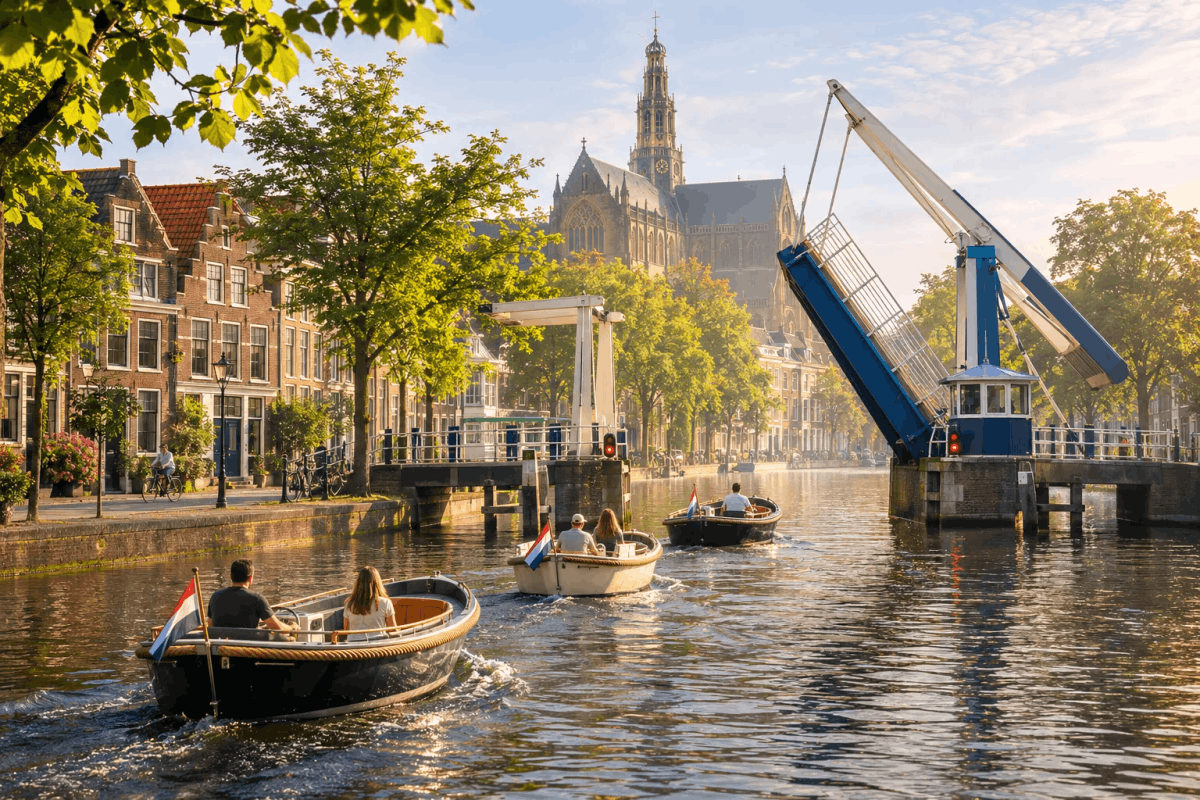
- From the north, report at the Waarderbrug. Works can close it (see below).
- From the south, report at the Buitenrustbrug.
- Call when you are at the bridge: VHF 18, or 023 511 3310.
- Wait clear of the bridge and the fairway until the convoy forms. Then follow the boat ahead and keep your spacing.
You cannot sail through under canvas. Article 33 of the Verordening Haarlemse Wateren, the city's water by-law, bans sailing under sail between the Waarderbrug and the Buitenrustbruggen, so take the sails down before you report.
Opening times
These are the city's published times on its page for passing boats, re-read on 7 November 2026:
- Weekdays, all year: 9:00 to 16:30, and 18:30 to 22:00. Nothing opens between 16:30 and 18:30.
- Weekends, 29 March to 31 October: 8:00 to 21:00.
- Winter Saturdays, 1 November to 28 March: 9:00 to 15:00.
- Winter Sundays: the bridges are not operated.
The cut-off is earlier than the closing time. To cross the whole city, be at the reporting bridge before 21:00 on a weekday or 20:00 at the weekend. Boats can still come in until 22:00 on weekdays and 21:00 at weekends, the same page says, but that is entry, not a promise of getting all the way through.
The railway bridge
The Spaarnespoorbrug (the railway bridge over the Spaarne, north of the centre) runs to the trains, not to the convoy. It turns twice an hour, at :06 and :36, on summer weekends, and on winter Saturdays between 9:00 and 15:00. It is not operated on Sundays in winter (haarlem.nl).
Closed, it gives 4.3 m by Rijkswaterstaat's figure, so most motorboats pass under it without waiting. It matters if you carry a mast or a high wheelhouse.
Works and closures
Works close bridges from time to time, and the city lists every current closure on the same page for passing boats: check it before you go. Two from autumn 2026 show what to expect:
- Waarderbrug: closed to all boats from 2 to 8 November 2026. Boats could pass in both directions again from 9 November, but the works were planned into early 2027, with changes to expect at the northern reporting point.
- Leidsevaart: no passage at the Westelijke Randwegbrug (the N208) from 26 October 2026, while a new bridge was built.
Heat can shut the bridges too. On 26 June 2026 they stayed closed from 10:00 to 21:00 (Rodi Haarlem). On a hot summer day, check before you set off.
Do you need the convoy at all?
Only if your boat is too tall for the bridges while they are closed. Know your air draught: the height from the waterline to the highest point of the boat, with the canopy, windscreen and aerial down. Measure it once, at home, and write it on the dashboard.
The headroom under each closed bridge, north to south along the Spaarne, at normal water. Where Rijkswaterstaat (its FIS, the national waterway data) and the city (haarlem.nl) give different figures, we list the lower one and say what the other source gives:
- Schoterbrug: 6.2 m, the lowest figure the city gives (Rijkswaterstaat's lowest is 6.3 m); the two disagree on which span is lower, so read the board
- Waarderbrug: 2.0 m
- Prinsenbrug: 2.85 m
- Spaarnespoorbrug (the railway bridge): 4.3 m (the city gives 4.45 m)
- Catharijnebrug: 2.0 m (the city gives 2.2 m)
- Gravestenenbrug: 2.55 m (the city gives 3.45 m in the middle of the span and 2.75 m at the sides)
- Melkbrug: 2.0 m
- Langebrug: 2.15 m (the city gives 2.2 m)
- Buitenrustbrug: 2.15 m
- Schouwbroekerbrug: 4.31 m (the city gives 4.45 m)
Two more movable bridges sit lower still, both Rijkswaterstaat figures: the Figeebrug (Brug 2A), over the Industriehaven in the Waarderpolder, off the east bank of the Spaarne between the Waarderbrug and the Prinsenbrug, at 1.99 m (the city gives 2 m), and the Schalkwijkerbrug, on the Ringvaart at Cruquius, south of Haarlem and not on the Spaarne, at 1.21 m.
So the rule of thumb through the centre is about 2 metres. Under that, with margin, a small open boat can pass without waiting for the convoy. Close to it, treat it as a no and report.
The water level moves the figure
Published clearances assume a normal water level. Haarlem's water is part of the boezem (the regional storage water) of Rijnland, the water board, which holds it near NAP (the Dutch reference level) −0.61 m in summer and −0.64 m in winter. Rijnland publishes live levels of its boezem, including at the Spaarndam pumping station, but the figure to trust at a bridge is its height board.
When it is tight:
- Line up for the highest point of the span, and go dead slow.
- Put someone forward to watch the gap, and be ready to go astern.
- Remember the wake. A passing boat can lift you a few centimetres at the worst moment.
A note on rules
The times, reporting points and closures above come from the city's page for passing boats, re-read on 7 November 2026, and the sailing ban from its water by-law. Clearances are Rijkswaterstaat's and the city's published figures. Bridge times change with the season and with works, so re-check the city's page before you go, and follow the signals and the height boards at the bridge, which always win over any map, ours included. Floating Today lists suggestions, not permits. See our Terms.